If Ethtype Dpktethernetethtypeip print non Ip Packet Type Not Supported Continue
Lab - 2: Internet Protocol and Subnets
Objectives
The lab is on observations of:
-
IP packet format
-
Check the IP address and MAC address of interfaces
-
Learn about the tool,
ping, that is on IP connectivity
Load Lab Network
Use File  New Notebook to open a new notebook.
The labs are conducted using the University of Houston Education python libraries. Load these libraries by executing the following code in the first cell of your lab notebook:
You can now proceed with loading of the lab modules for this class:
Select your lab topology from the dropdown menu and then load by clicking the Build Network button.
In order to conduct this lab, please select IP Subnets in the labpicker dropdowm menu and then click on the Build Network button.
Topology Orientation
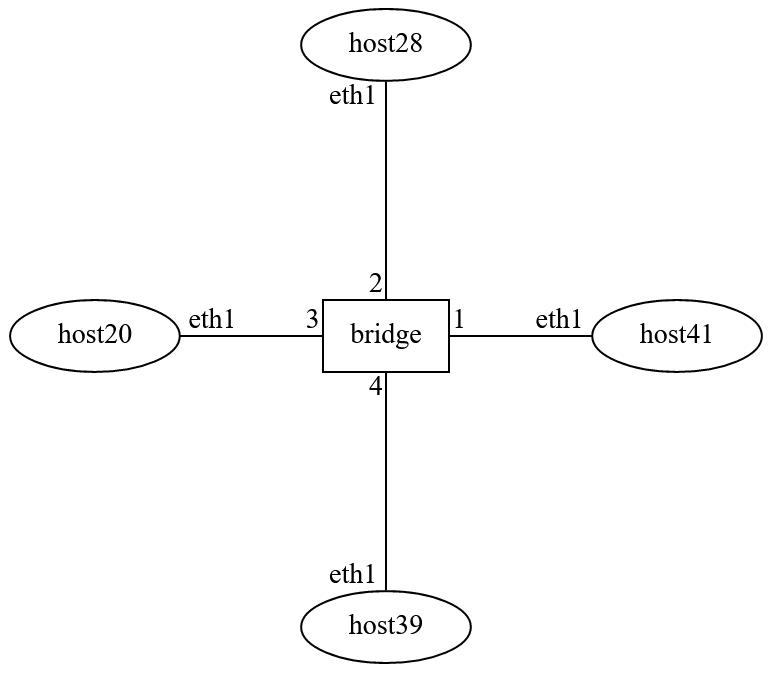
Lab Network Topology
Attention
Each time you make a reservation, the hosts will be numbered in a random manner.
Observation Plan and Environment
-
Open a terminal for each host, ssh into the hosts to identify their interfaces.
-
Examine the subnets provided to you for the lab. Allocate two addresses from each subnet to be assigned to two of your host interfaces in each subnet.
-
Assign the IP addresses to your host interfaces in your lab notebook:
NET [ < hostlabel > ] . setIPv4Address ( < interfacename > , < IPaddress > )
-
Verify the IP address of the interface of the host by looking at the output of the command:
-
Send packets using
ipsendtool as explained below and monitor the packets using thetcpdumptool at sending and/or receiving hosts. -
Send an ICMP
echo requestpacket using thepingtool to each IP address of the hosts to observe the IP connectivity.
Example IP Address Allocation and Assignment
Retrieve the subnets you have been assigned for this lab. Use the command below:
to display the subnets allocated to your lab.

For example, if the two subnets are 34.137.48.0/22 and 159.43.24.0/23 , the range of IP addresses that are available to assign to a network interface from each subnet are:
34.137 . 48.0 / 22 : 34.137 . 48.1 - 34.137 . 51.254 159.43 . 30.0 / 23 : 159.43 . 30.1 - 159.43 . 31.254 Attention
The first (min) and last (max) value in these ranges are reserved and not assigned to host interfaces.
The subnet address in each case is:
-
Subnet address:
34.137.48.0/22 -
Subnet address:
159.43.30.0/23
Tip
Finding the Range of IP Addresses in a Subnet
Use the tool netmask to display the range of IP addresses that are available in a given subnet on your lab notebook. Execute:
!netmask -r <subnetaddress> Where <subnetaddress> is in the form of A.B.C.D/N. For example:
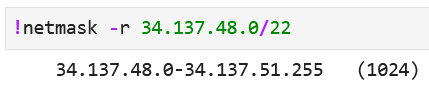
Let's pick the following assignments to the following host interfaces in this topology:
host03 . eth1 : 159.43 . 30.12 / 23 host12 . eth1 : 159.43 . 31.38 / 23 host34 . eth1 : 34.137 . 51.250 / 22 host35 . eth1 : 34.137 . 51.149 / 22 In order to assign these IP addresses, use the notebook commands. For example, the host03 assignment will be:
NET [ "host03" ] . setIPv4Address ( "eth1" , "159.43.30.12/23" ) 
Note
When using the command, NET[<hostlabel>].setIPv4Address(<interfacename>, <IPaddress>) , the <hostlabel> refers to the label or name you see in the network topology for that host node, like host03 . The <interfacename> refers to the network interface of the host, typically eth1 . Finally, the <IPaddress> in the command refers to the IP address to be assigned to the host interface in the format A.B.C.D/N where N refers to the subnet prefix length.
Network Interfaces: Set & Verify IP Addresses
Lab Task
Please run the command NET.showInterfaces() in your lab notebook to display the node interfaces and their addresses:
An example view from a lab notebook with interface IP and MAC addresses:
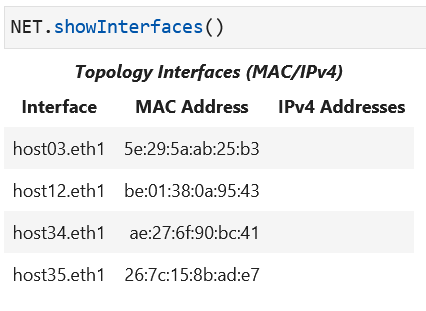
Please note that you can identify the MAC and IP address at the eth1 interface.
Assign an IP address to a host interface using the command to set an IPv4 address: NET[<hostlabel>].setIPv4Address(<interfacename>, <IPaddress>) .
Please retrieve the interface information for your topology again to verify that the assigned IP address is now showing up in the displayed table.
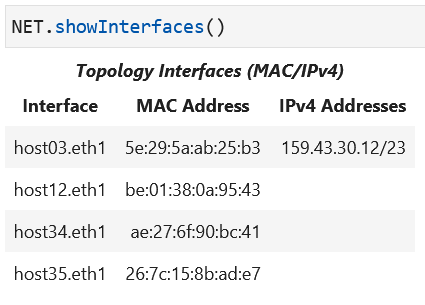
You can also login to the hosts in your topology to examine the interface addresses using the command ip addr . For example, in a reservation, here is the output we have recorded for the command ip addr :
/ # ip addr 1 : lo : < LOOPBACK , UP , LOWER_UP > mtu 65536 qdisc noqueue state UNKNOWN qlen 1000 link / loopback 00 : 00 : 00 : 00 : 00 : 00 brd 00 : 00 : 00 : 00 : 00 : 00 inet 127.0 . 0.1 / 8 scope host lo valid_lft forever preferred_lft forever 7304 : eth1 @if7303 : < BROADCAST , MULTICAST , UP , LOWER_UP , M - DOWN > mtu 1500 qdisc netem state UP qlen 1000 link / ether ae : 27 : 6 f : 90 : bc : 41 brd ff : ff : ff : ff : ff : ff inet 34.137 . 51.250 / 22 scope global eth1 valid_lft forever preferred_lft forever / # In this case, the IP address of the host eth1 interface is 34.137.51.250 with a prefix length of 22 for its subnet. The MAC address of host interface eth1 is ae:27:6f:90:bc:41 .
The host interface information (all host interfaces are called eth1 ) is tabulated below:
| hostname | Interface MAC | Interface IP |
|---|---|---|
| host03 | 5e:29:5a:ab:25:b3 | 159.43.30.12/23 |
| host12 | be:01:38:0a:95:43 | 159.43.31.38/23 |
| host34 | ae:27:6f:90:bc:41 | 34.137.51.250/22 |
| host35 | 26:7c:15:8b:ad:e7 | 34.137.51.149/22 |
Attention
Please repeat the process of identifying subnets, allocating IP addresses to host interfaces and then assigning them to those interfaces for your network now.
Learning Activities
Step 1
Use the provided subnets to allocate and then assign IP addresses to your host interfaces. Verify your address assignments using the output of NET.showInterfaces() output in your notebook.
Step 2
Use the command line tool called ping to send echo request packets to check their IP connectivity status.
2a. ssh into hosts in the topology and use ping at the command line to send an ICMP echo request within the subnet of the sending host.
2b. ssh into the same host where you are using the command ping to also monitor the packets being sent and received by the host, monitor packets using tcpdump using the command below:
tcpdump - i eth1 - Ane not ether dst 01 : 80 : c2 : 00 : 00 : 00 and not ether proto 0x86DD 2c. Observations:
Which hosts are connected at layer 3?
How does subnet addressing relate to layer 3 connectivity?
Step 3 – Lab2 Homework
In your lab notebook, run:
in a cell and complete the submission.
Source: https://cot-cn.cougarnet.uh.edu/docs/compnet/L020-ip-subnets.html
0 Response to "If Ethtype Dpktethernetethtypeip print non Ip Packet Type Not Supported Continue"
Post a Comment